



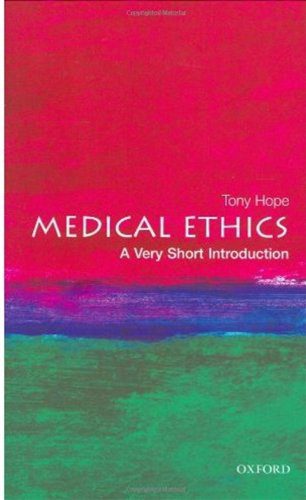
خرید و دانلود نسخه کامل کتاب Medical Ethics A Very Short Introduction Tony Hope – Original PDF
قیمت اصلی 141,000 تومان بود.87,000 تومانقیمت فعلی 87,000 تومان است.
تعداد فروش: 80
Author:
Tony Hope
Playing the Nazi card There is a common, but invalid, argument against euthanasia that I call ‘playing the Nazi card’. This is when the opponent of euthanasia says to the supporter of euthanasia: ‘Your views are just like those of the Nazis’. There is no need for the opponent of euthanasia to spell out the rhetorical conclusion: ‘and therefore your views are totally immoral’. Let me put the argument in a classic form used in philosophy and known as a syllogism (I will say more about syllogisms in Chapter 5): Premise 1: Many views held by Nazis are totally immoral. Premise 2: Your view (support for euthanasia under some circumstances) is one view held by Nazis. Conclusion: Your view is totally immoral. This is not a valid argument. It would be valid only if all the views held by Nazis were immoral. I will therefore replace premise 1 by premise 1* as follows: Premise 1*: All views held by Nazis are totally immoral. In this case the argument is logically valid, but in order to assess whether the argument is true we need to assess the truth of premise 1*. 8 Medical Ethics There are two possible interpretations of premise 1*. One interpretation is a version of the classic false argument known as argumentum ad hominem (or bad company fallacy): that a particular view is true or false, not because of the reasons in favour or against the view, but by virtue of the fact that a particular person (or group of people) holds that view (see Warburton, 1996). But bad people may hold some good views, and good people may hold some bad views. It is quite possible that a senior Nazi was vegetarian on moral grounds. This fact would be irrelevant to the question of whether there are, or are not, moral grounds in favour of vegetarianism. What is important are the reasons for and against the particular view, not the person who holds it. Hitler’s well-known vegetarianism, by the way, was on health, not on moral, grounds (Colin Spencer, 1996). The other, more promising, interpretation of premise 1* is that those views that are categorized as ‘Nazi views’ are all immoral. Some particular Nazis may hold some views about some topics that are not immoral, but those would not be ‘Nazi views’. The Nazi views being referred to are a set of related views, all immoral, that are driven by racism and involve killing people against their will and against their interests. Thus, when it is said that euthanasia is a Nazi view, what is meant is that it is one of these core immoral views that characterize the immoral Nazi worldview. The problem with this argument, however, is that most supporters of euthanasia – as it is practised in the Netherlands for example – are not supporting the Nazi worldview. Quite the contrary. Those on both sides of the euthanasia debate agree that the Nazi killings that took place under the guise of ‘euthanasia’ were grossly immoral. The point at issue is whether euthanasia in certain specific circumstances is right or wrong, moral or immoral. All depends on being clear about these specific circumstances and being precise about what is meant by euthanasia. Only then can the arguments for and against legalizing euthanasia be properly evaluated. What is needed is some conceptual clarity. 9 Euthanasia Clarifying concepts in the euthanasia debate Let us begin with some definitions (see next page). The purpose of these is twofold: to make distinctions between different kinds of euthanasia; and to provide us with a precise vocabulary. Such precision is often important in evaluating arguments and reasons. If a word is used in one sense at one point in the argument, and in another sense at another point in the argument, then the argument may look valid when in fact it is not. If you study these definitions it will be immediately clear that playing the Nazi card rides roughshod over some important distinctions. The first point is that the term euthanasia, at least as I am suggesting that it should be used, implies that the death is for the person’s benefit. What the Nazis did was to kill people without any consideration of benefit to the person killed. The second point 3. Those opposed to active voluntary euthanasia often play the ‘Nazi card’. 10 Medical Ethics Euthanasia and suicide: some terms Euthanasia comes from the Greek eu thanatos meaning good or easy death. Euthanasia: X intentionally kills Y, or permits Y’s death, for Y’s benefit. Active euthanasia: X performs an action which itself results in Y’s death. Passive euthanasia: X allows Y to die. X withholds or withdraws life-prolonging treatment. Voluntary euthanasia: Euthanasia when Y competently requests death himself, i.e. a competent adult wanting to die. Non-voluntary euthanasia: Euthanasia when Y is not competent to express a preference, e.g. Y is a severely disabled newborn. Involuntary euthanasia: Death is against Y’s competent wishes, although X permits or imposes death for Y’s benefit. Suicide: Y intentionally kills himself. Assisted suicide: X intentionally helps Y to kill himself. Physician assisted suicide: X (a physician) intentionally helps Y to kill himself. (Adapted from T. Hope, J. Savulescu, and J. Hendrick, Medical Ethics and Law: The Core Curriculum (Churchill Livingstone, 2003).) Euthanasia is that euthanasia can be voluntary, involuntary, or non-voluntary. The third point is that it can be active or passive. Let us start with the first point.
نقد و بررسیها
هنوز بررسیای ثبت نشده است.